Dr. Mariam Jashi at the 158th Session of the WHO Executive Board
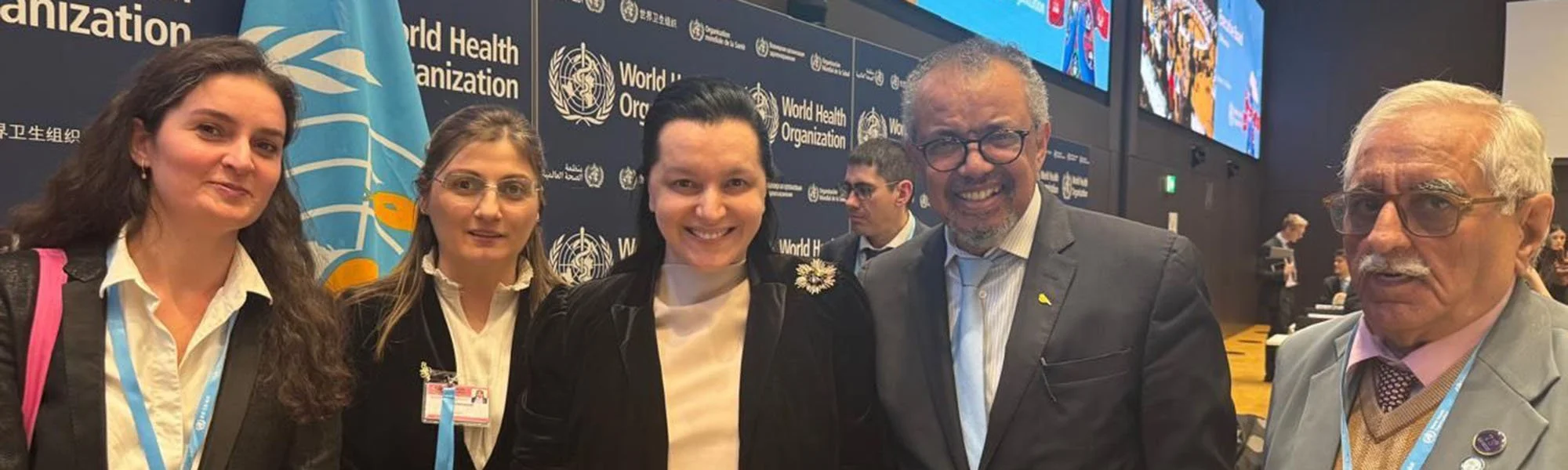
Geneva, Switzerland | 2–7 February 2026
Dr. Mariam Jashi, CEO of the Global Sepsis Alliance and Secretary General of the Medical Women’s International Association, participated in the WHO Executive Board 158th Session (EB158), held in Geneva, Switzerland.
As Head of the MWIA delegation, Dr. Jashi delivered six official statements addressing key agenda items, with a strong emphasis on the health and well-being of women, female medical professionals, and the integration of Sepsis into national and global health agendas.
Key Themes and Messages
Agenda Item 6: Noncommunicable Diseases (NCDs)
Drawing on MWIA’s 106-year legacy and representation of 12,000 female health professionals worldwide, Dr. Jashi welcomed progress in reducing NCDs among women in parts of Central Asia, the Middle East, and North Africa. She cautioned, however, that socio-economic disparities continue to limit access to and affordability of basic NCD care, urging greater investment in prevention, control, and women-centred research and development within Universal Health Coverage (UHC) frameworks.
Agenda Item 8: Immunization
Dr. Jashi reaffirmed that immunization remains one of the most successful public health interventions, having saved an estimated 154 million lives over the past 50 years. She cautioned that anti-vaccine sentiment threatens historic gains at a time when the world is closer than ever to eradicating polio and achieving measles elimination.
Together with the Global Sepsis Alliance, Dr. Jashi emphasized that immunization is one of the strongest preventive measures against Sepsis, a medical emergency claiming 11 million lives annually. She urged Member States to strengthen investments in immunization programmes at national, regional, and global levels to meet IA2030 targets and avert 50 million deaths worldwide.
Combined Agenda Items 9 and 11: Integrated Emergency, Critical and Operative Care (ECO) and Health-Related SDGs
On Agenda Item 9, Dr. Jashi strongly endorsed the draft global strategy for integrated Emergency, Critical and Operative care (ECO), highlighting its importance as a people-centred continuum of care essential for both Universal Health Coverage and health security.
To accelerate progress toward health-related Sustainable Development Goals, Dr. Jashi proposed three concrete actions:
Reaffirm commitment to global health and increase domestic financing, especially in the context of challenged multilateralism.
Strengthen engagement with parliamentarians to co-create evidence-based health policies and budgets.
Prioritize Sepsis, which accounts for 20% of global deaths, affecting 26 million women and 20 million children under five.
Combined Agenda Items 13 and 14: Health Workforce Mobility and Antimicrobial Resistance (AMR)
On Agenda Item 13, Dr. Jashi welcomed the Expert Advisory Group’s report on the international recruitment code and stressed that women—who comprise 67% of the global health workforce—are disproportionately affected by international recruitment practices. She called for the Code to reflect this reality and promote equitable employment opportunities for medical women.
Addressing Agenda Item 14, she emphasized that Sepsis is the Human Face of AMR. The 4.7 million AMR-associated deaths estimated in 2021 are part of the broader burden of 21 million Sepsis-related deaths, underscoring the need to urgently synergize AMR and Sepsis policies and actions.
Agenda Item 17: Strengthening the Evidence Base for Public Health and Social Measures
Dr. Jashi described Agenda Item 17 as a critically important milestone in building a stronger evidence-based national and global health architecture. She advocated that guidance on public health and social measures extend beyond emergencies to inform good governance, routine strategic planning, and budget alignment, and highlighted the role of non-State actors in evidence consolidation through WHO knowledge platforms. She further encouraged WHO to provide practical tools to help governments and parliaments design robust health policies and budgets, align international aid, and engage non-State actors in evidence generation and consolidation.
Agenda Item 26: Economics of Health for All
MWIA welcomed the draft strategy on the Economics of Health for All and its commitments to equity and gender equality. Dr. Jashi underscored that achieving health for all requires deliberate prioritization of women facing the greatest barriers. She highlighted that 66% of the poorest women globally lack access to universal health coverage due to financial constraints and that 20% of women still require permission to seek health care. She also underscored the leadership gap whereby women constitute nearly 70% of the health workforce but hold only 25% of leadership roles.
Conclusion
Across all interventions, Dr. Jashi consistently highlighted the need to:
Center women and female health professionals in global health decision-making,
Elevate Sepsis across immunization, AMR, and ECO agendas, and
Strengthen evidence-based health governance at national and global levels.
The Global Sepsis Alliance expresses its gratitude to the Medical Women’s International Association for the ongoing strategic partnership and the opportunity to jointly advance the urgent action needed against Sepsis to avert millions of preventable deaths and disability worldwide.