Shaping Fluid Stewardship: IFAD 2026 in Antwerp, December 3-5, 2026
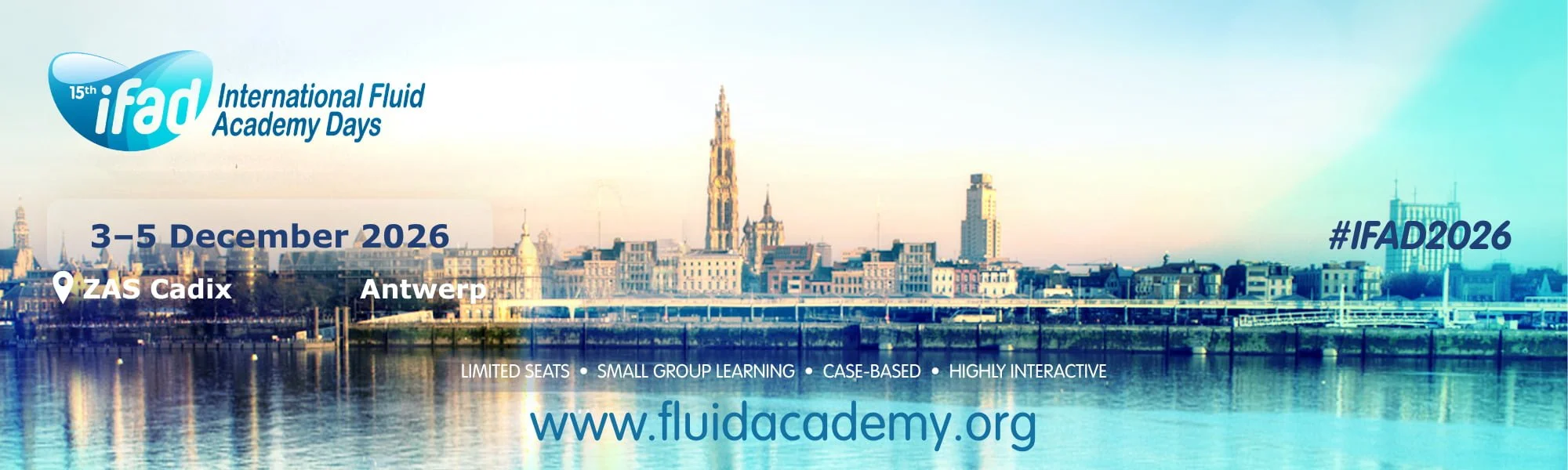
A reimagined 3‑day, course-based meeting on fluid stewardship, hemodynamic monitoring, and physiology-driven critical care, IFAD 2026 marks the 15th anniversary of the International Fluid Academy Days with an intentionally small, highly interactive program designed to translate physiology into real bedside decisions for multidisciplinary clinicians.
Introduction – Why Antwerp in December 2026?
From 3–5 December 2026, Ziekenhuis Aan de Stroom (ZAS) Cadix, Antwerp, Belgium, will host the 15th anniversary edition of the International Fluid Academy Days (IFAD 2026).
This landmark meeting brings together clinicians who care for acutely ill and perioperative patients to focus on one central theme: doing fluid therapy better, through structured, interactive learning.
Unlike a traditional large congress, IFAD 2026 has been reimagined as a course-based experience where every session is designed to connect physiology, monitoring, and clinical reality. Antwerp provides the backdrop for a three-day journey that is deliberately paced, integrated, and geared toward practical change in daily practice.
A different kind of critical care meeting
IFAD 2026 is explicitly designed as a course-based, interactive meeting focused on clinical practice, not as a passive, auditorium-driven congress. The organizers have built the program around the premise that learning is most effective when it is active, structured, and clinically relevant.
Instead of long lectures delivered to hundreds of silent listeners, the meeting emphasizes small-group teaching, case-based discussions, interactive sessions, and direct exchange with international experts. Participants are not just attendees; they become active contributors in a shared learning environment where questions, doubts, and local practices are openly discussed. This format creates space to explore complex fluid decisions and hemodynamic dilemmas in depth, with faculty guidance.
A structured three-day learning journey
The IFAD 2026 program is intentionally constructed as a progressive three-day pathway, where each day builds on the previous one. The aim is to move from fundamentals to advanced application in a logical, clinically meaningful sequence.
Day 1 – Foundations of fluid therapY
The first day concentrates on the core principles of fluid management. Participants revisit key aspects of fluid physiology and fluid types, and work through the fundamentals of maintenance, replacement, and resuscitation strategies.
Interactive and case-based sessions are used in the afternoon to reinforce these concepts and connect them directly to typical clinical scenarios, such as early shock resuscitation or perioperative fluid prescriptions. By the end of the day, participants should have a clearer, physiology-driven framework for deciding when and how to start fluids, and how to avoid inappropriate or excessive administration.
Day 2 – Applying principles to real patients
On Day 2, the focus shifts to applying fluid therapy principles in perioperative and critical care settings. Sessions explore electrolyte disturbances, organ-specific challenges, and complex clinical contexts where fluids interact with vasopressors, ventilation, and organ support.
Extended case-based discussions allow participants to walk step by step through real-world situations, from the emergency department to the operating room and ICU. Questions such as “How do I adapt my fluid strategy in a patient with coexisting kidney injury and respiratory failure?” or “What does this hemodynamic monitoring profile mean for my next fluid decision?” can be explored with faculty and peers.
Day 3 – Advanced concepts and integration
The final day brings the learning journey to an advanced level, focusing on fluid-related pathophysiology, organ interactions, metabolic disturbances, and AI. Participants examine how cumulative fluid balance, capillary leak, venous congestion, and organ cross-talk influence outcomes in critically ill and high-risk surgical patients.
IFAD 2026 concludes with an interactive quiz and diploma-style session, designed to consolidate learning, highlight key take-home messages, and ensure that participants leave with a coherent, integrated view of fluid stewardship. The three days are offered as a continuous course; participation is structured as a full 3-day experience rather than single-day drop-in attendance, protecting continuity and progression.
Educational philosophy: active, structured, clinically grounded
The educational philosophy behind IFAD 2026 is clear: learning should be active, structured, and directly linked to bedside decisions. The meeting uses small groups, interactive formats, and real cases to keep participants engaged and to mirror the complexity of real clinical practice.
Participation is intentionally limited to preserve interaction and ensure that every clinician has the opportunity to ask questions, debate options, and receive feedback from faculty. Rather than expanding in size, this 15th edition focuses on refining how we learn – prioritizing depth over breadth, and dialogue over one-way communication. Over the past 15 years, the International Fluid Academy has contributed to education and research in fluid management; IFAD 2026 represents the next chapter in that journey by focusing on the quality of the learning environment.
What you will take back to the bedside
IFAD 2026 is designed so that participants not only acquire new knowledge but also develop practical strategies for implementation in their own units. Throughout the three days, the emphasis remains on translating physiology and hemodynamic monitoring into concrete, patient-centered decisions.
Clinicians can expect to leave with:
A clearer, stepwise approach to fluid assessment and prescription, from maintenance to resuscitation
An improved understanding of how to integrate hemodynamic monitoring into decision-making, rather than using it in isolation
Practical insights into preventing and managing fluid overload, congestion, and organ dysfunction
Frameworks to support fluid stewardship programs and more rational, team-based fluid management in daily practice
By working through cases in an interactive setting, participants can stress-test these concepts against their own experience and local protocols, making change more feasible once they return to their hospitals.
Who should attend
IFAD 2026 is aimed at multidisciplinary clinicians involved in fluid therapy and the care of acutely ill or high-risk surgical patients. Intensivists, anesthesiologists, emergency physicians, internists, perioperative clinicians, and advanced practice nurses or physician assistants with an interest in critical care and perioperative medicine will all find the content directly relevant.
The structure of the meeting makes it accessible to participants with different levels of prior exposure to advanced hemodynamic concepts. Early-career clinicians can use the course to build a robust foundation, while experienced practitioners can refine their practice, update their knowledge, and benchmark their own approaches against international perspectives. The limited group size and emphasis on discussion create a setting where diverse disciplines can learn from each other and build shared language around fluid stewardship.
Practical details and next steps
IFAD 2026 – the 15th anniversary International Fluid Academy Days – will take place from 3–5 December 2026 in ZAS Cadix, Antwerp, Belgium. The meeting is offered as a three-day, course-based experience, with a structured program that progresses from foundational principles to advanced clinical application and an interactive quiz/diploma-style closing session.
Participation is intentionally limited to protect interaction and ensure the quality of the learning journey. A detailed program, including session formats and faculty list, will be released and updated over time on the official website. Information on registration, logistics, and any future updates will also be provided there as they become available.
Visit the official International Fluid Academy website to explore IFAD 2026: