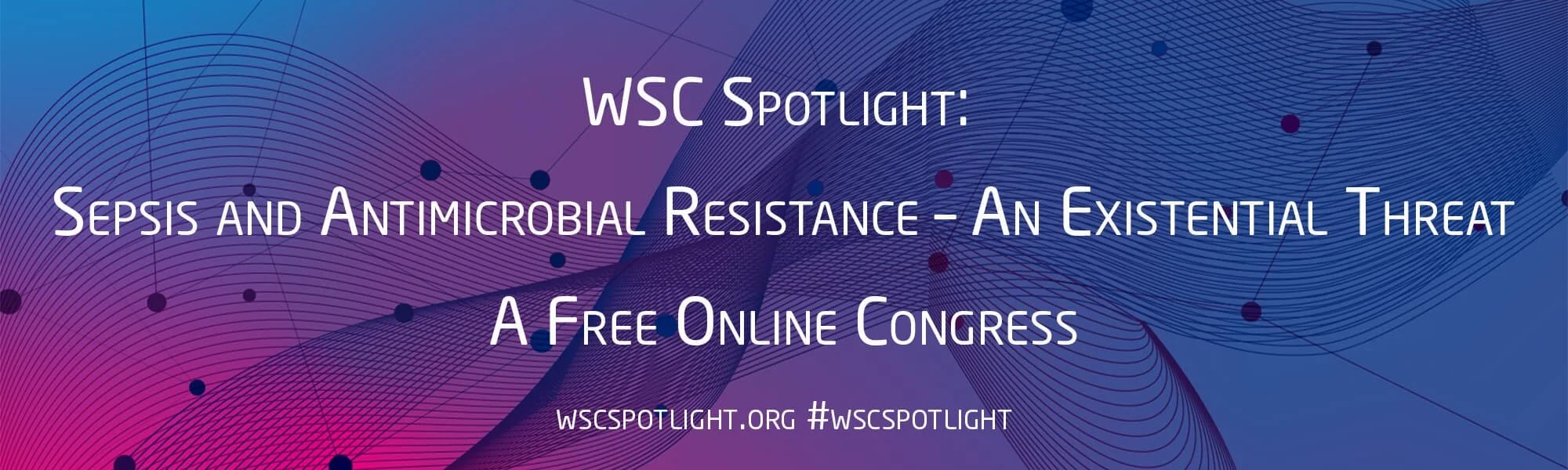
Save the Date - March 11th, 2020 - WSC Spotlight: Sepsis and Antimicrobial Resistance – An Existential Threat
2020WSCSPotlightBanner.jpg

Update January 27th, 2020: Due to unforeseen circumstances, we will have to postpone the 2020 WSC Spotlight - it will not take place on March 11th, 2020. Subsequently, registrations will not start in January 2020, either. We will update this post as soon as we know the new date.

Original article:

On March 11th, 2020, we will bring you the ‘WSC Spotlight: Sepsis and Antimicrobial Resistance – An Existential Threat’, an innovative and free online congress exploring the relationship between sepsis and antimicrobial resistance.

Over the course of 8 sessions, around 50 speakers from multiple countries and backgrounds will give short but insightful talks – ranging from framing the global burden of AMR and sepsis, to potential synergies in the fight against both, to how inequalities impact responses to sepsis globally, and much, much more.

Registrations will open in January 2020, and the full program, incl. all speakers and time zones, will be available at that time as well.

Add to Calendar
Congress Website
Learn More About World Sepsis Congress and WSC Spotlight

World Sepsis Congress is a free online congress bringing knowledge about sepsis to all parts of the world. All the large World Sepsis Congresses take place every two years in the even years (1st WSC in 2016, 2nd WSC in 2018, 3rd WSC in 2020, and so on), while in the uneven years in between, WSC Spotlight shines a spotlight on one specific issue of sepsis.
All talks from World Sepsis Congress and WSC Spotlight are recorded and are available on our YouTube Channel and on Apple Podcasts. They have been accessed over 260,000 times as of December 2019.

YouTube Channel
Apple Podcasts
Marvin Zick
Project Presentation – How the German Sepsis Aid Is Supporting Sepsis Survivors in Germany

In June, we announced the winners of the 2019 Global Sepsis Awards. In addition to the five winners, nine other entities were commended for their valuable contribution in the global fight against sepsis.

Over the coming months, we will give both the 2019 GSA Award Winners as well as the activities and initiatives by the entities that were commended the possibility to share their projects and initiatives in more detail on our websites, and after our colleagues from Italy in June, the project “Stop Sepsis in Croatia” in July, and the ‘6th Annual Jeff Davis Sepsis Challenge 5K’ in September, we would like to introduce the German Sepsis Aid today.


The German Sepsis Aid

DSH Deutsche Sepsis Hilfe German Sepsis Aid Banner.jpg

The German Sepsis Aid (Deutsche Sepsis-Hilfe e.V., DSH) was founded in 2007 and is the world's first association of sepsis patients and their relatives.

The DSH provides a unique platform for sepsis-survivors and their families to connect with each other, to share experiences, to find support, and to attend trainings. People who are aware of sepsis by own experience volunteer to give practical and psychosocial assistance and information, according to the principle of „sepsis patients help sepsis patients“.

The current number of members is 351. The DHS is a non-profit-organization, which is financed exclusively by donations, membership fees, and subsidies of health insurance companies.

The work of the DSH focuses on 4 main areas:

  1. Support and Counseling for Patients, Relatives, and Surviving Relatives

    Central to the work of the DSH is the "sepsis-hotline”, a phone-helpline that was set up for those who have questions about sepsis. The number is 0700 73774700 and can be reached daily between 08:00 and 21:00h. Those who have been affected by sepsis themselves have first-hand experience and can therefore give a good first response.

    Additional inquiries are made by email or using the contact form on the DSH website, with the total number of requests exceeding 500 annually. Specific medical questions can be forwarded to physicians or a psychologist who volunteers for the DSH.

    Currently, a network is being set up regarding certain long-term effects of sepsis. DSH members, who e.g. suffer from cognitive impairment or amputations, have agreed to be available as contact persons in case of specific physical harm.

  2. Creation and Distribution of Information Materials

    Upon request, the inquirers can receive detailed information material free of charge, e.g. the booklet “Informationen für Betroffene und Angehörige“ (Information for Patients and Relatives) which was edited by the DSH.

  3. Educating the General Public and Creating Awareness

    Another task of the association is to raise awareness for sepsis. Therefore, the DSH is present at numerous public events with an information booth. Furthermore, the DSH provides information on its homepage and its Facebook page. On request, the association is able to organize public training events on sepsis.

  4. Support Services to Members of the DSH

    Once a year, a meeting for all DSH members takes place. In addition to lectures and yearly reports, the two-day meeting will focus on the exchange between the members. Twice a year, members receive an exclusive newsletter.

DSH Website
DSH Facebook Page

The Global Sepsis Awards, which are sponsored by the Erin Kay Flatley Memorial Foundation, honor outstanding efforts to increase sepsis awareness and raise the quality of sepsis prevention and management.

The awards are granted in three categories, namely governments and healthcare authorities, non-governmental organizations, patient advocate or healthcare provider groups, and individuals, consistent with the aims of the World Sepsis Declaration and the World Sepsis Day Movement.

Winners in category II and III will receive $2,500 prize money each. Applications and nominations for the 2020 GSA Awards open in January 2020 and close on March 31st, 2020.


Marvin Zick
The Launch of Sepsis Alliance Pakistan and the Adoption of the Karachi Sepsis Declaration
Karachi Sepsis Declaration Wide.jpg

On November 19th, 2019, the Sepsis Alliance Pakistan (SoAP) was launched by a diverse group of 43 doctors in Pakistan, as well as the Karachi Sepsis Declaration adopted. Honorable Governor Sindh Imran Ismail himself signed the Karachi Sepsis Declaration at the Sindh Governor House, Karachi, Pakistan.


Karachi Sepsis Declaration

Commitment to Improve Sepsis Awareness, Early Recognition, Prevention, Care, and Research in Pakistan

Sepsis results when the body’s response to an infection injures its own tissues leading to vital organ failure and critical illness if not managed early and appropriately. It is responsible for killing over 6 million people per year worldwide, claiming more lives than bowel and breast cancer combined.

Sepsis does not discriminate against age, gender, religion, social status or geographic borders. An estimated 60-80% of deaths in developing countries like Pakistan occur due to sepsis. Low standards of living, poor hygiene, malnutrition, limited access to healthcare facilities and weak health systems contribute to the disproportionately high morbidity and mortality from sepsis in our region.

We acknowledge that;

  • Despite the unacceptable number of deaths and disabilities caused by sepsis, the awareness of sepsis among healthcare providers and laypeople in the country is very low.

  • There is usually an unacceptable delay in recognizing sepsis and a wide variation in practice among doctors to treat sepsis.

  • Hospital-acquired infections (HAI) and antimicrobial resistance (AMR) are a major healthcare issue in the country.

  • National policies to improve prevention, recognition, and treatment of sepsis are lacking in Pakistan.

On November 19th 2019, members of various medical societies urge government authorities, policy makers, healthcare managers, professionals and philanthropists to help us to;

  • Promote Sepsis Awareness among lay people and healthcare workers, by commemorating World Sepsis Day every year on September 13th and throughout the year by focused activities.

  • Prioritize Sepsis Prevention by promoting practices of good general hygiene and hand washing, improvement in sanitation, clean deliveries and nutrition, and encouraging vaccination in high-risk groups.

  • Reduce the time-to-recognize sepsis by front line physicians and the variation in Sepsis Management in hospitals and intensive care units through undergraduate and postgraduate education and training of healthcare professionals.

  • Encourage hospital managements to adopt measures aimed at minimizing the risk of development and spread of AMR and HAI.

  • Facilitate collaborative Sepsis Research in the country through establishment of sepsis registries to document burden of disease in Pakistan and identify vulnerable groups and cost effective interventions to improve outcomes.

  • Guide policy makers formulate a National Action Plan to adopt the WHO resolution (WHA 70.7) of May 2017 for improving the prevention, diagnosis and clinical management of sepsis

We encourage representatives of various professional societies of physicians, surgeons, paediatricians, emergency and intensive care medicine, infectious diseases and microbiology, public health and nurses from government and nongovernment organizations to join hands with Sepsis Alliance Pakistan (SoAP) to fight sepsis in our country.

Download Karachi Sepsis Declaration (PDF)
Marvin Zick
We Moved Our Office – New Address and Telephone Number
Banner.jpg

We would like to inform you that we have moved our office from Jena to Berlin this week. We are now based at the Charité University Hospital Berlin, in this beautiful brutalist style building that houses a variety of specialities, including immunology, virology, and now, sepsis.


New Visitor Address

Global Sepsis Alliance
c/o Charité University Hospital
Hindenburgdamm 27
12203 Berlin
Germany

New telephone number

+49 30 450551419

Contact Us
 

Marvin Zick
2019 World Sepsis Day Event Poster Now Available to Download + Order Printed Copies + Feedback Survey
Banner.jpg

Update December 23th, 2019: Orders for printed posters are now closed. You can of course still print it yourself by downloading the print version below.

Update December 5th, 2019: Thanks for the corrections - everything you have sent us has been implemented, you can download the updated poster below.


Original Article:

Download Poster

The 2019 World Sepsis Day Event Poster is now available, summarizing hundreds of events and activities that took place this World Sepsis Day to raise awareness for sepsis. The poster is available in a ‘view version’ and in a ‘print version’, the latter for you to print and display within your organization or institution. Please note that the print version is 20 MB, so depending on your internet connection, the download may take a couple of minutes. The view version is 4.4 MB.

Download 2019 Poster - View Version
Download 2019 Poster - Print Version
 

Order Printed Copies

Additionally, until Sunday, December 22nd, 2019, you can order printed copies of the poster - shipped free of charge to your home or office, as a thanks for your support of World Sepsis Day. Please understand this offer is limited to 3 copies per institution.

Order Printed Copies
 

Report Mistakes

Assembling and designing the poster is a monumental task - if you find any mistakes, please let us know. We’ll fix them and re-upload a corrected version.

Contact Us
 

Feedback

Again, the WSD Event Poster is an enormous task every year. As a non-profit organization, we have to constantly question how we allocate our scarce resources - is it even worth designing, printing, and shipping physical posters half-way around the world in 2019? How could an alternative look like? Please participate in this 2-minute survey and let us know what you think - your opinion matters!

Give Feedback 📝
 

Donate to Support Our Cause

A huge thanks to everybody who held an event for World Sepsis Day this year - you are amazing, and you are contributing to the global fight against sepsis. Thank you!

❤️Donate to Support World Sepsis Day ❤️
Marvin Zick
Asia Pacific Sepsis Alliance Launches New Website and Unveils New Logo
Asia Pacific Sepsis Alliance Logo.png

Our colleagues from the Asia Pacific Sepsis Alliance (APSA) have launched their new website and unveiled their new logo last Friday - asiapacificsepsisalliance.org.

The APSA was founded in Bangkok in October 2018 and is one of the regional sepsis alliances we are establishing all around the world to work closer with national stakeholders, regional governments, and the WHO regional offices, to implement changes on how sepsis is prioritized, diagnosed, and treated all around the world, as laid out by the WHO Resolution on Sepsis.

APSA Website
ASA Website
WHO Resolution on Sepsis
ESA Website
Marvin Zick
The GSA Supports the Joint Call on Patient Safety and Healthcare-Associated Infection Prevention and Control
Joint Call Wide.jpg

The Global Sepsis Alliance is happy to support the Joint Call on Patient Safety and HAI Prevention and Control. A healthcare-associated infection (HAI) is an infection that occurs in a patient during the process of care in a hospital or healthcare facility, which was not present (or incubating) at the time of admission to said facility.

About 20% of sepsis cases can be attributed to HAIs – the remaining 80% are contracted outside of a healthcare facility. Therefore, preventing infections in hospitals is a crucial step to improve patient safety and decrease both sepsis cases and the overuse of antibiotics. Every infection prevented is an antibiotic treatment avoided.

Download Joint Call (PDF)
Marvin Zick
November 18th to 24th Is World Antibiotic Awareness Week - Relationship Between Antibiotics and Sepsis
WAAR Banner 2019.jpg

Each November, World Antibiotic Awareness Week increases global awareness of antibiotic resistance and encourages best practices among the general public, healthcare workers, and policy makers.

Sepsis and antibiotics are closely linked – sepsis can occur as the result of antimicrobial resistance and is the driving need for antimicrobial stewardship. Antibiotics are the only really effective treatment for sepsis - for every hour the correct ones aren’t administered, the risk of death increases.

However, this is not the case for all illnesses, so it is crucial to preserve antibiotics for conditions that really need them. For example, nearly 40% of E.coli, the bacteria that causes a huge number of infections, are now resistant to antibiotics, and these organisms account for up to one third of sepsis cases, showing the vital need for responsible use of antimicrobials.

The Global Sepsis Alliance and the World Sepsis Day Movement strongly believe that fighting sepsis with responsible use of antimicrobials and combating antimicrobial resistance can be achieved at the same time.

This is why we are planning on partnering with the WHO to bring you the ‘WSC Spotlight: Sepsis and Antimicrobial Resistance – An Existential Threat’ in early 2020 - stay tuned for more infos soon…

Download Campaign Material
Learn More About Sepsis
WSC Spotlight 2020
Marvin Zick