Now Live: Central Press Conference in Berlin – 2025 World Sepsis Day

We are now live from Berlin with the 2025 WSD Central Press Conference:

Please use the chat function on YouTube to ask questions and interact with us. The event recording will be available immediately after the livestream has concluded.


How many lives could be saved if Sepsis were recognized as the global health emergency it truly is?

Journalists and media representatives are warmly invited to join us in Berlin – or via livestream – for the Central Press Conference on World Sepsis Day 2025: “5 Facts × 5 Actions”.

Sepsis is responsible for 1 in 5 deaths worldwide, and every 3 seconds, someone dies from Sepsis. Yet it remains dramatically under-prioritized by governments and health systems.

This event will explore HOW millions of lives can be saved through prevention, early detection, and stronger policy action – and WHY urgent attention is needed now.

The press conference will feature the Special Video Address of Dr. Tedros Ghebreyesus, WHO Director-General, marking the 2025 World Sepsis Day.

It will bring together leading voices from global health, science, and advocacy, including:

  • Prof. Dr. Detlev Ganten – Co-Founder, Virchow Foundation | Founding President, World Health Summit (Chair)

  • Hon. Dr. Mariam Jashi – CEO, Global Sepsis Alliance | Former Chair of the Parliamentary Committee and Deputy Minister of Health of Georgia

  • Prof. Dr. Andrew Ullman – UNITE Parliamentarians Network for Global Health

  • Prof. Dr. Konrad Reinhart – President, Sepsis Stiftung | Member of the German National Academy of Sciences Leopoldina

  • Prof. Mohsen Naghavi – Institute for Health Metrics and Evaluation (IHME), presenting new global estimates on Sepsis (Video Address)

  • Prof. Dr. H.E. Stefan Kaufmann – Founding Director Emeritus, Max Planck Institute for Infection Biology | Leopoldina Member

  • Prof. Dr. Peter Suter – Co-Founder, Swiss Sepsis Program | Board Member, Sepsis Stiftung

The central highlight of the event will be addresses and testimonials from patients and families directly affected by this devastating medical emergency, including:

  • Youssef Kdami – Father of a 2-year-old son with quadruple amputation after Sepsis (Video Address)

  • Mariah McKimbrough – Sepsis Survivor | Executive Director, Sepsis Stiftung

  • Kerstin Martensen – Founder, Jann-190.dd & Initiator of “Jülich arms itself against Sepsis”, in memory of her son

Their powerful stories will underscore the urgent need for greater awareness, stronger health system responses, and global collaboration to combat Sepsis.


Registration & Attendance in Person

Please note that in-person attendance is by invitation only. If you are a member of the media and would like to attend, both in-person and remotely is possible, please contact us. To receive a reminder when the livestream on YouTube starts, please register using the form below.


Co-Organizers of the Event

  • Global Sepsis Alliance (GSA)

  • Sepsis Stiftung

  • Virchow Foundation

  • UNITE Parliamentarians Network for Global Health

  • German Health Alliance (GHA)

  • Team Stop Sepsis

  • Swiss Sepsis Program (SSP)

Marvin Zick
Register to Attend UNGA80 Side Event on Sepsis and NCDs in New York on September 24

Join high-level policymakers, global health leaders, sepsis advocates, and scholars at the parallel Side Event to the 80th Session of the United Nations General Assembly (UNGA80) on “Sepsis and NCDs  – A Hidden Link in Global Health” on September 24, 2025.

Register Now

For in-person participation, please register by September 17, 2025.


Co-Sponsor Organizations

  • Global Sepsis Alliance (GSA)

  •  Medical Women’s International Association (MWIA)

  • UNITE Parliamentarians Network for Global Health (UNITE)

  • Sepsis Stiftung

  • END SEPSIS – the Legacy of Rory Staunton

  • Virchow Foundation

  • German Health Alliance (GHA)

  • Sepsis Alliance

  • American Medical Women’s Association


Why Sepsis and NCDs?

Sepsis is among the leading causes of mortality, disability, and healthcare expenditures worldwide, responsible for approximately 20% of all annual deaths. According to the latest estimates from the Institute of Health Metrics and Evaluation (IHME) and the University of Oxford, in 2021, Sepsis, as an immediate or intermediate cause, was related to 21 million deaths, including 4 million deaths associated with or attributable to AMR. A reinvigorated Sepsis response is essential to accelerate progress towards health-related SDG 3 and 8, other Sustainable Development Goals.

15.8 million Sepsis cases, and 5.1 million Sepsis-related deaths annually arise from infections as complications/exacerbation of NCDs or injuries. Though the intersection of Sepsis with non-communicable diseases is often overlooked in global health dialogues. People living with NCDs – such as diabetes, cancer, cardiovascular disease, and chronic respiratory illnesses – are significantly more vulnerable to infections and, consequently, to Sepsis. At the same time, Sepsis Survivors often experience long-term sequelae, including the development or exacerbation of NCDs.

This bi-directional relationship underscores the need to integrate Sepsis prevention, early detection, and management into NCD strategies and broader UHC and health system strengthening efforts.


Objectives of the Side Event

This side event will spotlight the overlooked Sepsis–NCD link and mobilize coordinated, cross-sectoral action by: 

  1. Reaffirming the urgency of political leadership for scaling up the 2030 Global Agenda for Sepsis to prevent 12 million new cases of Sepsis and avert 2 million avoidable deaths.

  2. Emphasizing the critical need for reinvigorated Sepsis responses at global, regional, and national levels to achieve health-related SDGs – including aspirations for UHC and NCDs.

  3. Raising awareness of the clinical and policy links between Sepsis and NCDs within the context of Universal Health Coverage and SDG 3.

  4. Promoting the recognition of the NCD-Sepsis nexus and the need for integration of Sepsis prevention and management in national NCD strategies and UHC packages.

  5. Discussing strategies to catalyze political leadership, funding, and partnerships for the 2030 Global Agenda for Sepsis, including scalable models that link Sepsis and NCD care,  especially in LMICs.


Target Audiences

  • UN Member States and permanent missions

  • WHO and other UN agencies

  • Civil society organizations, patient groups, and health advocates

  • Researchers and academics

  • Development partners and philanthropic organizations

Marvin Zick
Join Us in Geneva on September 15 for Our 2025 World Sepsis Day Event

Join distinguished speakers from the WHO, Geneva-based global health partners, and leading Sepsis experts from Switzerland, Canada, Germany, Georgia, Greece, the United Kingdom, and the United States at the 2025 World Sepsis Day event on September 15.


Event: “5 Facts × 5 Actions on Sepsis” — Accelerating the Global Response to Sepsis

Time: September 15, 2025, 14:00 - 16:00

Venue: InterContinental Genève, Chemin du Petit-Saconnex 7–9, 1209 Geneva, Switzerland
Registration is open till September 13, 2025, for in-person participation.

Meeting Format: Hybrid Event, Livestreamed to our YouTube Channel


Co-organizers:

  • Global Sepsis Alliance

  • Virchow Foundation

  • Health Diplomacy Alliance

  • UNITE Parliamentarians Network for Global Health

  • European Sepsis Alliance

  • Sepsis Stiftung

  • Swiss Sepsis Program


Register Now

Registration is open till September 13, 2025, for in-person participation.


About the 2025 World Sepsis Day

Sepsis remains one of the leading causes of death, disability, and healthcare costs worldwide. Affecting 48.9 million people annually and responsible for nearly 1 in 5 global deaths, Sepsis is a largely invisible global health emergency. It disproportionately affects vulnerable populations, including 20 million children, 26 million women, older adults, and immunocompromised individuals.

According to the latest estimates from the Institute of Health Metrics and Evaluation (IHME) and the University of Oxford, in 2021 alone, Sepsis was linked to 21 million deaths (as an immediate and intermediate cause), including 4 million deaths associated with or attributable to antimicrobial resistance (AMR).

Since 2012, over 54,000 stakeholders from 170 countries -  including policy makers, national health authorities, healthcare providers, researchers, innovators, advocates, Sepsis survivors, families affected by this devastating medical emergency, and medical students – mark the World Sepsis Day (WSD) on September 13.

World Sepsis Day was initiated by the Global Sepsis Alliance (GSA) – the largest professional and advocacy network in the fight against Sepsis. WSD campaign events are held by GSA members and partners across Africa, Asia-Pacific, Europe, Eastern Mediterranean, Latin America and the Caribbean, and North America. These campaigns include scientific conferences, training sessions, media outreach, and the launch of national, regional, or global initiatives on Sepsis literacy or advocacy.

World Sepsis Day campaigns were convened under the Patronage of Dr. Tedros Adhanom Ghebreyesus, WHO Director-General, and the Federal Health Minister of Germany in 2023 and 2024.

2024 World Sepsis Day was marked by the historic launch of the 2030 Global Agenda for Sepsis at the German Parliament, the first multi-year strategy to prevent 12 million new Sepsis cases and save 2 million lives over the next 5 years.

The 2025 World Sepsis Day aims to further this momentum by emphasizing public awareness, political leadership, and strategic investments under the theme “5 Facts x 5 Actions” — to catalyze multisectoral engagement and prioritize Sepsis in global health planning.


Objectives of the Event

The meeting aims to bring together multiple stakeholders engaged in the fight against Sepsis – pubic, private, civil society, and academic actors - to:

  • Reaffirm the urgency of political commitment to the 2030 Global Agenda for Sepsis to prevent 12 million new cases from Sepsis and avert 2 million avoidable deaths.

  • Emphasize the critical need for reinvigorated Sepsis responses at global, regional, and national levels to achieve health-related Sustainable Development Goals, including Universal Health Coverage aspirations.

  • Raise awareness of the 2025 World Sepsis Day Theme “5 Facts x 5 Actions” highlighting key data and actionable steps for stronger positioning Sepsis on the Global Health Agenda.  

  • Discuss strategies for catalyzing partnerships and funding streams (both traditional and innovative) to accelerate Sepsis science, research, and innovations.


Target Audience

  • Permanent Missions of the Member States to the United Nations in Geneva

  • UN Agencies: WHO, UNICEF, UNFPA, UNDP, UNHCR, IOM

  • Bi- and multilateral development agencies

  • Sepsis survivors and patient organizations

  • Civil society organizations and global health advocates

  • Researchers, academic institutions, and Think Tanks

  • Philanthropic organizations and foundations

  • Private sector leaders and health innovators

  • Media representatives

Marvin Zick
Invitation to the Central Press Conference in Berlin – 2025 World Sepsis Day

How many lives could be saved if Sepsis were recognized as the global health emergency it truly is?

Journalists and media representatives are warmly invited to join us in Berlin – or via livestream – for the Central Press Conference on World Sepsis Day 2025: “5 Facts × 5 Actions”.

Sepsis is responsible for 1 in 5 deaths worldwide, and every 3 seconds, someone dies from Sepsis. Yet it remains dramatically under-prioritized by governments and health systems.

This event will explore HOW millions of lives can be saved through prevention, early detection, and stronger policy action – and WHY urgent attention is needed now.

The press conference will feature the Special Video Address of Dr. Tedros Ghebreyesus, WHO Director-General, marking the 2025 World Sepsis Day.

It will bring together leading voices from global health, science, and advocacy, including:

  • Prof. Dr. Detlev Ganten – Co-Founder, Virchow Foundation | Founding President, World Health Summit (Chair)

  • Hon. Dr. Mariam Jashi – CEO, Global Sepsis Alliance | Former Chair of the Parliamentary Committee and Deputy Minister of Health of Georgia

  • Prof. Dr. Andrew Ullman – UNITE Parliamentarians Network for Global Health

  • Prof. Dr. Konrad Reinhart – President, Sepsis Stiftung | Member of the German National Academy of Sciences Leopoldina

  • Prof. Mohsen Naghavi – Institute for Health Metrics and Evaluation (IHME), presenting new global estimates on Sepsis (Video Address)

  • Prof. Dr. H.E. Stefan Kaufmann – Founding Director Emeritus, Max Planck Institute for Infection Biology | Leopoldina Member

  • Prof. Dr. Peter Suter – Co-Founder, Swiss Sepsis Program | Board Member, Sepsis Stiftung

The central highlight of the event will be addresses and testimonials from patients and families directly affected by this devastating medical emergency, including:

  • Youssef Kdami – Father of a 2-year-old son with quadruple amputation after Sepsis (Video Address)

  • Mariah McKimbrough – Sepsis Survivor | Executive Director, Sepsis Stiftung

  • Kerstin Martensen – Founder, Jann-190.dd & Initiator of “Jülich arms itself against Sepsis”, in memory of her son

Their powerful stories will underscore the urgent need for greater awareness, stronger health system responses, and global collaboration to combat Sepsis.


Registration & Attendance in Person

Please note that in-person attendance is by invitation only. If you are a member of the media and would like to attend, both in-person and remotely is possible, please contact us. To receive a reminder when the livestream on YouTube starts, please register using the form below.


Co-Organizers of the Event

  • Global Sepsis Alliance (GSA)

  • Sepsis Stiftung

  • Virchow Foundation

  • UNITE Parliamentarians Network for Global Health

  • German Health Alliance (GHA)

  • Team Stop Sepsis

  • Swiss Sepsis Program (SSP)

Marvin Zick
Global Webinar for Journalists: Saving Millions of Lives from Sepsis

Update: The recording is now available to rewatch above or directly on YouTube.


Original article:

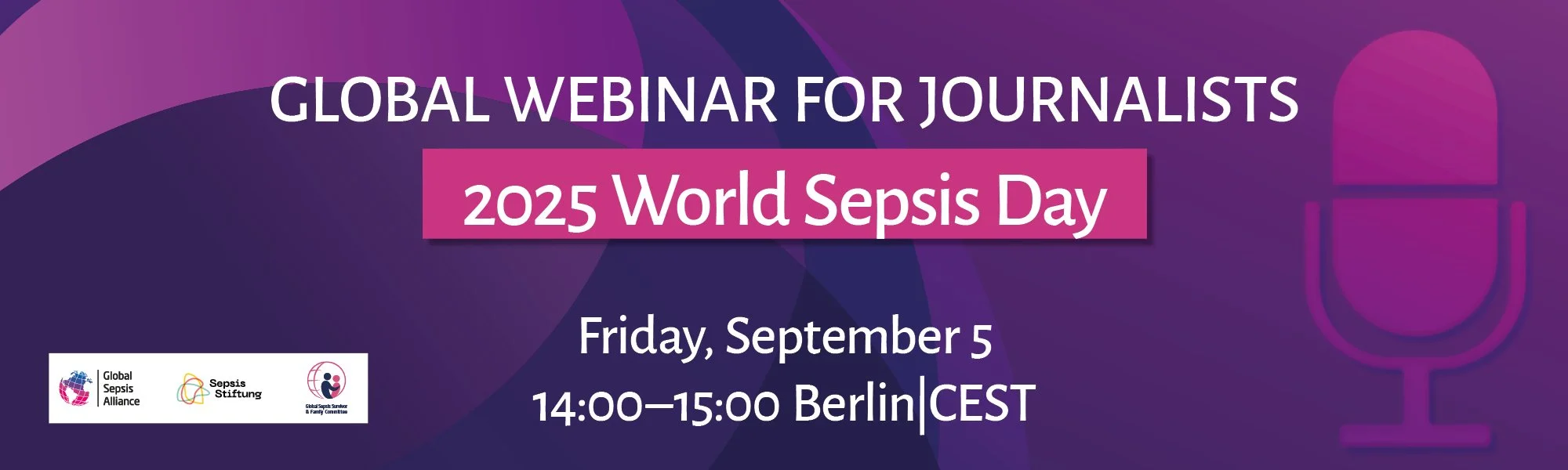
The Global Sepsis Alliance, the Sepsis Stiftung, in coordination with the Global Sepsis Survivor and Family Committee (GSSFC) are delighted to invite journalists to a global webinar on September 5, at 2pm CEST. The webinar will be held on Zoom. Check the links below to register, and consult the programme and the media and policy brief “5 Facts for 5 Actions”. The webinar is aimed at media, but open to everyone.


Questions That Could Save Millions of Lives

  • Why is Sepsis causing 20% of all deaths worldwide, still largely invisible in public policies and media coverage?

  • How can the media help save millions of children, women, and men from Sepsis?

  • How can we jointly hold health leaders and policymakers accountable for action on Sepsis?

  • How can journalists turn Sepsis into a household term like cancer, stroke, or heart attack?

To explore these urgent questions and strengthen Sepsis visibility in the media ahead of World Sepsis Day 2025 (September 13), the Global Sepsis Alliance (GSA) and the Sepsis Stiftung, in coordination with the Global Sepsis Survivor and Family Committee (GSSFC), are convening a Global Webinar for Journalists on September 5.

 This 60-minute webinar will equip media professionals and Sepsis advocates with data, stories, and practical tools to raise awareness and inspire global action against one of the world’s deadliest yet most overlooked health emergencies.

Objectives of the Webinar

  • Raise awareness of Sepsis as a leading yet preventable cause of death and disability

  • Share personal stories that bring a human face to the statistics

  • Present the “5 Facts × 5 Actions” framework for World Sepsis Day 2025

  • Share 2030 Global Agenda for Sepsis and other evidence-based resources and toolkits for impactful media coverage

  • Foster partnerships between journalists, Sepsis survivors, researchers, and health leaders

Target Audience

  • Journalists (TV, radio, print, digital) at national, regional, and global levels

  • Health and science correspondents

  • Media development organizations

  • Journalism schools and students

Register now and be part of a global movement to make Sepsis visible — and help save at least 2 million lives by 2030. A registration is desirable, but you can also join the webinar directly via this link.

Simone Mancini
Global Sepsis Alliance Welcomes New Board for 2025 to 2028

Last week, our member organizations came together to elect the Global Sepsis Alliance Board for the 2025–2028 term. The new Board brings together experts and advocates from across all regions of the world – from Africa and Asia to Europe, the Americas, and Oceania – reflecting the truly global nature of our mission. Its members hail from countries including Saudi Arabia, South Africa, Spain, the UK, Canada, Greece, New Zealand, Uganda, Sweden, Belgium, the US, Japan, Australia, Brazil, India, and Nigeria.

The following 20 candidates have been elected to the GSA Board for the 2025-2028 Triennium:

  • Prof. Niranjan ‘Tex’ Kissoon, Canada – GSA’s President

  • Dr. Ron Daniels, United Kingdom, Europe

  • Prof. Sheila Myatra, India, Asia Pacific

  • Prof. Steve McGloughlin, Australia, Asia Pacific

  • Prof. Alison Fox-Robichaud, Canada, North America

  • Dr. Andrew Argent, South Africa, Africa

  • Ulrika Knutsson, Sweden, Europe

  • Prof. Imrana Malik, United States, North America

  • Prof. Antonio Artigas, Spain, Europe

  • Dennis Kredler, Belgium, Europe

  • Halima Salisu-Kabara, Nigeria, Africa

  • Maha Aljuaid, Saudi Arabia, Eastern Mediterranean

  • Ciaran Staunton, United States, North America

  • Dr. Shevin Jacob, Uganda, Africa

  • Dr. Naoyuki Matsuda, Japan, Asia Pacific

  • Ally Hossain, New Zealand, Asia Pacific

  • Dr. Rafael Barberena Moraes, Brazil, Latin America

  • Prof. Evangelos Giamarellos-Bourboulis, Greece, Europe

  • Dr. Abdulelah Alhawsawi, Saudi Arabia, Eastern Mediterranean

  • Dr. Mitchell Levy, United States, North America

We are proud that the Board also reflects a diverse range of perspectives and experiences, with 35% female and 65% male representation, ensuring a breadth of voices in our leadership.

We are especially pleased to share that Prof. Niranjan ‘Tex’ Kissoon has been re-elected as President of the GSA. His tireless dedication, vision, and leadership will continue to guide our global efforts in awareness, prevention, innovation, and care improvement.

We thank all candidates for their willingness to serve, including the ones not elected, and our member organizations for their active engagement. We look forward to working together over the coming years to advance our shared goal: reducing the impact of sepsis worldwide.

Marvin Zick
Get Ready for World Sepsis Day 2025 – Explore the Theme, Download the Toolkits, and Start Planning

Today, we’re excited to announce the theme for World Sepsis Day 2025: “5 Facts × 5 Actions.” This year’s focus highlights five key truths about sepsis and five urgent steps we can all take to help save lives. Our official Policy and Media Brief is now available to download and share.

In preparation for September 13, we’ve also updated our World Sepsis Day Infographics and Sepsis Awareness Posters for 2025 — with refreshed visuals and updated data. Additionally, our World Sepsis Day Toolkit Section features brochures, fact sheets, event guides, photo boards, quizzes, wallpapers, video clips, and more. All materials are free to use and available in multiple languages to support your outreach online and offline.

Finally, we’ve published our updated event inspiration guide for 2025 — packed with ideas to help you mark World Sepsis Day in your community. Whether it’s a pink picnic, a local media campaign, a hospital training, or a digital awareness post, every action counts.

Start planning today — explore the toolkits, share the message, and help ensure that fewer lives are lost to sepsis, a silent killer that too often goes unrecognized.

Marvin Zick
“This Was Not a Regular Cold”: A Mother’s Story of Sepsis and Survival

It was late winter 2023, and my then 6-year-old daughter, Francesca, caught a cold. Nothing unusual for a cold Berlin winter and a child who goes to kindergarten. But the cold turned into an ear infection, high fever, and relentless symptoms. I visited our pediatrician three days in a row, followed by a visit to the hospital emergency room. Everyone assured us this was just a cold or the flu, and an ear infection, nothing to worry about. But I knew different. I could see it in her. This was not a regular cold.

Then came a new symptom, elbow and knee pain. Again, a visit to the pediatrician, again sent home. Symptoms kept getting worse, along with very high fever. Her pain became so severe that she could not walk to the bathroom unassisted, and this is when a rash started on her body. Again, we went to the pediatrician, carried since she could no longer walk. By then, the small rash had turned purple on her legs, and she was lethargic as well. After another examination, our doctor sent us to the hospital. 

We arrived at the emergency room, which was packed, and waited. Her rash was getting rapidly worse, a dark deep purple all over her legs. Once we are finally seen and blood is drawn, we are told that we will be admitted to the hospital. We were given Covid tests and admitted. Then chaos ensued, one doctor came in, followed by another, and another, and another. My daughter was suddenly surrounded by 7 doctors, frantically talking, taking blood, and hooking her up to machines. She was so dehydrated that getting an IV took several people.  We were asked so many questions to help doctors determine what caused this, from where we were born, where we had traveled to, had we been around people who traveled abroad, describing every symptom she’d had, and countless more.

My heart was sinking, my husband looked equally scared, and my daughter was crying and calling out for me. Finally, the head of the ER addressed us and explained that my daughter’s CRP levels, which determine inflammation in the body, were dangerously high. Any number above 10 requires hospitalization; her levels were at 326. Our doctor had never seen such a high number in his career. The next hours were like living in a nightmare. We saw countless doctors, they performed countless tests, and we were informed she needed to be moved to another hospital as the ICU was full there, yet she was not stable enough to move. It took hours to stabilize her and over 15 attempts for a 3rd IV to be placed, in a makeshift ICU room, with caring doctors and nurses that could no longer hide the severity of the situation.

We were finally able to move her, in an ICU ambulance, to the top hospital in the country, which, lucky for us, is in Berlin.  We arrived, again, to a myriad of doctors inspecting her. Another cardiologist woken up to once again perform the 3rd ultrasound of her heart. We spent a sleepless night in the ICU. Doctors did not have the heart to send my husband away, even though only 1 parent is allowed to stay. My daughter was finally asleep and in no pain; she slept for over 48 hours.

The next day, she continued to be stable, and we were sent to the Intermediate Care unit. This is when questions started again about everything, from our routines, traveling, family members, etc. While in intermediate care, we were seen by cardiologists, infectious disease experts, rheumatologists, surgeons, and countless more. Her blood was drawn and tested every 2 hours. When she finally woke, I could sense the relief in her doctors. She was tired but talking and against odds in good spirits. She still slept most of the day and night, but every day she felt more and more like herself. 

We were eventually sent to the regular ward and spent many days there, where she regained strength through physical therapy and eventually was strong enough to sit in a chair and walk again. Questions still went unanswered. What had caused this? I was told that if we spent 2 months in the hospital and walked away with a healthy daughter, I would be very lucky.

We spent a total of 25 days in the hospital. She took antibiotics for 6 months afterward, but against all odds, she made a full recovery.  Her strength and will to fight was praised by everyone we met in the hospital. We would never know what caused sepsis, and sepsis was never mentioned by our team of doctors and nurses. We would understand the severity of her case upon being discharged, with her medical records. She had arrived in septic shock to the ER, and organ failure had begun.

We still go to regular checkups for her myositis (elbow & knee), and this is something she will need to monitor her entire life. However difficult, her story has a happy ending; she is a thriving 8-year-old, happy as can be. 

It has now been two and a half years since that terrifying time. Today, I am part of the Global Sepsis Alliance. Not every family is as lucky as ours, and I feel a responsibility to raise awareness about this often-overlooked disease. Sepsis can move fast and be devastating—but with more awareness, earlier recognition, and better advocacy, more lives can be saved. I hope that by sharing our story, I can help prevent other families from going through what we did.


The article above was written by Karla Koch and is shared here with her explicit consent. The views in the article do not necessarily represent those of the Global Sepsis Alliance. They are not intended or implied to be a substitute for professional medical advice. The whole team here at the Global Sepsis Alliance and World Sepsis Day wishes to thank her for sharing her daughter’s story and for fighting to raise awareness for sepsis.

Katja Couball